
Vortices physics
1. Study about theory and phenomena of vortex in superconductive material
Superconductivity is one of great scientific discoveries of the 20th century with two major characteristics, i.e., it expels magnetic field and it conducts electric current with zero resistance. However, both properties are compromised in high magnetic field, they can penetrate the material and create a mixed state of quantized vortices. The vortices are moving in response to an electrical current, dissipating energy by flux flow and eventually destroying the zero-resistance states. Therefore, the studying methods prevent vortex motion to ensure zero electrical resistance become once of important research in developing applications of superconductivity in future. Beside, vortex in superconductor exhibits a rich variety of phenomena, e.g., the vortex can interact with the transport currents, temperature gradients, sample surfaces, defects and other vortices. The experimental study become one of the most important issues in practical application of superconductors. In this requirement, the studies about SQUID devices and scanning SQUID system would be helpful to improve resolution of vortex images and eliminate influence of sensor to vortex and expand observing vortex in three directions. In recent years, my studies have focused on understanding how vortex distributions were controlled by artificial elements in specific samples such as star-shaped pattern without pinning and pinning [1], circular disk with sector defect and different opening angles of deficit [2]. We developed a software to improve resolution of vortex images. A vector SQUID sensor was also designed and the sensor fabrication with the aid of superconducting fabrication center of CRAVITY [3]. The basic characteristics of sensor showed rationality of our design [4]. However, we need some modification in next design to improve sensitive of sensor. A concept of scanning SQUID system was constructed which is ready to combine with vector SQUID sensor. Details of my research would like to present by three topics listed as follows:
Vortex distribution in controlled artificial elements.
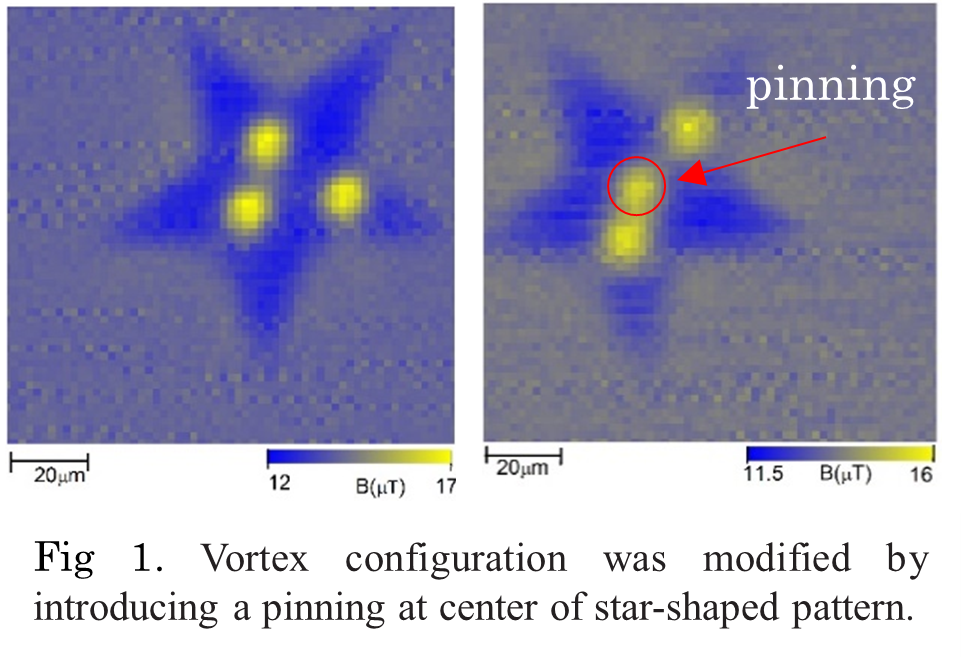
Vortices in small sized superconductors are very interesting due to exotic configurations emerged by magnetic field, temperature, and sample geometry. Beside, by using a special geometry patterns or introducing an artificial element can control the distribution of vortex. They are not only useful to study vortex structure was influenced by geometric pattern, they are also helpful to apply the prevention of vortex motion. In this study, we fabricated Mo80Ge20 thin films with difference shapes [1] and introduce artificial elements such as pinning and defect a sector of circular [2]. The sample was cooled in the magnetic field from a temperature above Tc down to 4 K, and the vortex penetration into the sample was directly imaged by means of a scanning SQUID microscopy. Systematic measurements allow us to reveal how vortices are confined in a restricted sample space as well as how vortex arrangement evolves with increasing the applied magnetic field. We also found that the artificial elements modified strongly vortex configuration (Fig. 1). However, vortex distribution always tries to adapt with symmetric geometry of pattern. My results are in good agreement with prediction by the Ginzburg-Landau calculations obtained for mesoscopic geometries of samples. I concluded from my systematic studies on this subject that the vortex-vortex interaction and the vortex-boundary interaction are mainly responsible for determining the particular vortex configuration in the mesoscopic system [1-2], [5-8].
Improvement of the spatial resolution of scanning SQUID microscope
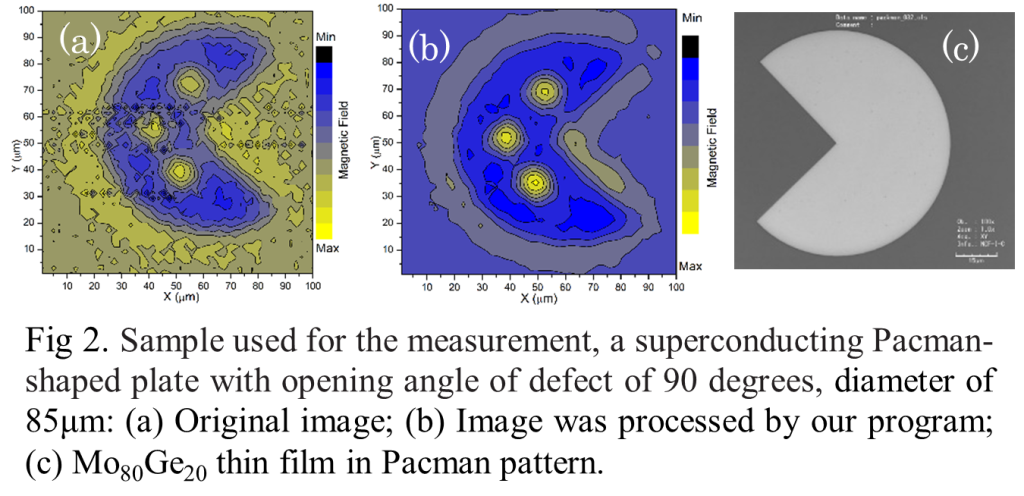
A unique feature of my own research is collaborations with the leading excellent theorists for enhancing resolution of scanning SQUID microscope (SSM). The SSM is undoubtedly an apparatus with the best magnetic sensitivity in all existing magnetic imaging techniques, while the spatial resolution is limited typically to the size of the pick-up coil (~10 μm). Thanks to the rapid progress of nano-fabrication technique, there is an increasing demand for the improvement of spatial resolution of SSM. I have developed a method for improving the resolution of SSM by applying an inverse transformation, which fully takes account of the details of the pick-up coil geometries, i.e., the size of the pick-up coil, the tilting of the pick-up coil with respect to the sample surface, the separation between the pickup coil and the sample surface, the perfect diamagnetism of the pick-up coil body. The program worked well as removing almost the cracking data, noise, the curving of magnetic field. This software also is very useful to observe two vortices was overlapped or they are a big vortex (Fig. 2). I clearly demonstrated that the resolution of SSM can be enhanced beyond the limitation of the diameter of the pick-up coil by using actual experimental observations. This program will be useful to develop an image processing program in three directions in future. The program was being updated and used for vortex image process. Our results have presented in some conference and workshop [9-11].
Reference
[1]. Vu The Dang, Hitoshi Matsumoto, Hiroki Miyoshi, Ho Thanh Huy, Hiroaki Shishido, Masaru Kato and Takekazu Ishida, “Vortex Distribution in Small Star-Shaped Mo80Ge20 Plate”, Physica C, Vol. 533(2017), Pages 44–48.
[2] Vu The Dang, Ho Thanh Huy, Hitoshi Matsumoto, Hiroki Miyoshi , Shigeyuki Miyajima, Hiroaki Shishido, Masaru Kato and Takekazu Ishida, “Ginzburg-Landau calculations of circular Mo80Ge20 plates with sector defect”, Physics Procedia Vol. 81, pp. 93-96. DOI:10.1016/j.phpro.2016.04.036.
[3]. Vu The Dang, Ho Thanh Huy, Shigeyuki Miyajima, Hitoshi Matsumoto, Hiroki Miyoshi, Takuto Okamoto, Masaaki Maezawa, Mutsuo Hidaka and Takekazu Ishida, “Scanning SQUID Microscope for Sensing Vector Magnetic Field”, Journal of IEEE, ISEC2015 (2015), 15721011. DOI:10.1109/ISEC.2015.7383478.
[4] Vu The Dang, Masaki Toji, Ho Thanh Huy, Shigeyuki Miyajima, Hiroaki Shishido, Mutsuo Hidaka, Masahiko Hayashi and Takekazu Ishida,”Vector sensor for scanning SQUID microscopy” Journal of Physics: Conference Series (JPCS).
[5]. Hitoshi Matsumoto, Ho Than Huy, Hiroki Miyoshi, Takuto Okamoto, Vu The Dang, Masaru Kato and Takekazu Ishida, “Vortex Distribution in Amorphous Mo80Ge20 Plates with Artificial Pinning Center”, Physica C, Vol. 530, pp. 46–50 (2016).
[6]. Hiroki Miyoshi, Masaru Kato, Ho Thanh Huy, Vu The Dang, Hitoshi Matsumoto, Norio Fujita and Takekazu Ishida, “Ginzburg-Landau calculations of star-shaped Mo80Ge20 superconducting small plates”, Physics Procedia Vol. 81, pp.89–92 (2016).
[7]. Atsuki Ito, Ho Thanh Huy, Vu The Dang, Hiroki Miyoshi, Masahiko Hayashi, and Takekazu Ishida, “Numerical restoration of surface vortices in Nb films measured by a scanning SQUID microscope”, Journal of Physics: Conference Series (JPCS)
[8]. Hiroki Miyoshi, Atsuki Ito, Vu The Dang, Ho Thanh Huy, Masahiko Hayashi, Masaru Kato, and Takekazu Ishida, “Simulations of vortices in a star-shaped plate with an artificial pin”, Journal of Physics: Conference Series (JPCS),
[9 ]. Vu The Dang, H. T. Huy, A. Ito, H. Miyoshi, M. Toji, S. Miyajima, H. Shishido, M. Maezawa, M. Hidaka, M. Hayashi, M. Kato and T. Ishida, “Vector Scanning SQUID system for High Spatial Resolution” Vortex Matter Physics Workshop Japan 2016 (VPWJ2016) in Akita, Japan.
[10]. Vu The Dang, Ho Thanh Huy, Hitoshi Masutmoto, Hiroki Miyoshi, Hiroaki Shishido, Masaru Kato, Masahiko Hayashi and Takekazu Ishida, “Vortices in a mesoscopic Pacman-shaped Mo80Ge20 plate” JPS September Meeting, Kanazawa University, September 13-16, 2016.
[11]. Vu The Dang, Ho Thanh Huy, Hitoshi Masutmoto, Hiroki Miyoshi, Hiroaki Shishido, Masaru Kato and Takekazu Ishida, “Vortex configuration in small Packman plate”, Japan Physics Society Spring conference 2016, Tohoku Gakuin University, Mar. 19-22th, 2016, 21-bAR-4.