

Ab s t r a c t:
In this study, we investigated the vortex states in small, star-shaped Mo80Ge20 plates using both theoretical and experimental methods. For our theoretical approach, we conducted numerical calculations using the Ginzburg-Landau equation with the aid of the finite element method, which is well-suited for dealing with arbitrarily shaped superconductors. Experimentally, we observed the results with a scanning SQUID microscope.
Through systematic measurements, we discovered that vortices form a symmetric configuration as the magnetic field increases. The vortex distribution tends to align with one of the five mirror-symmetric lines of the star-shaped plate, especially when the vortices are located at the five triangular horns. The sample’s crystalline homogeneity, confirmed by X-ray diffraction and its superconducting properties, enabled the vortices to easily move and conform to the plate’s geometric symmetry.
The experimental vortex configurations obtained from the star-shaped plate were in good agreement with the theoretical predictions from the nonlinear Ginzburg-Landau equation.
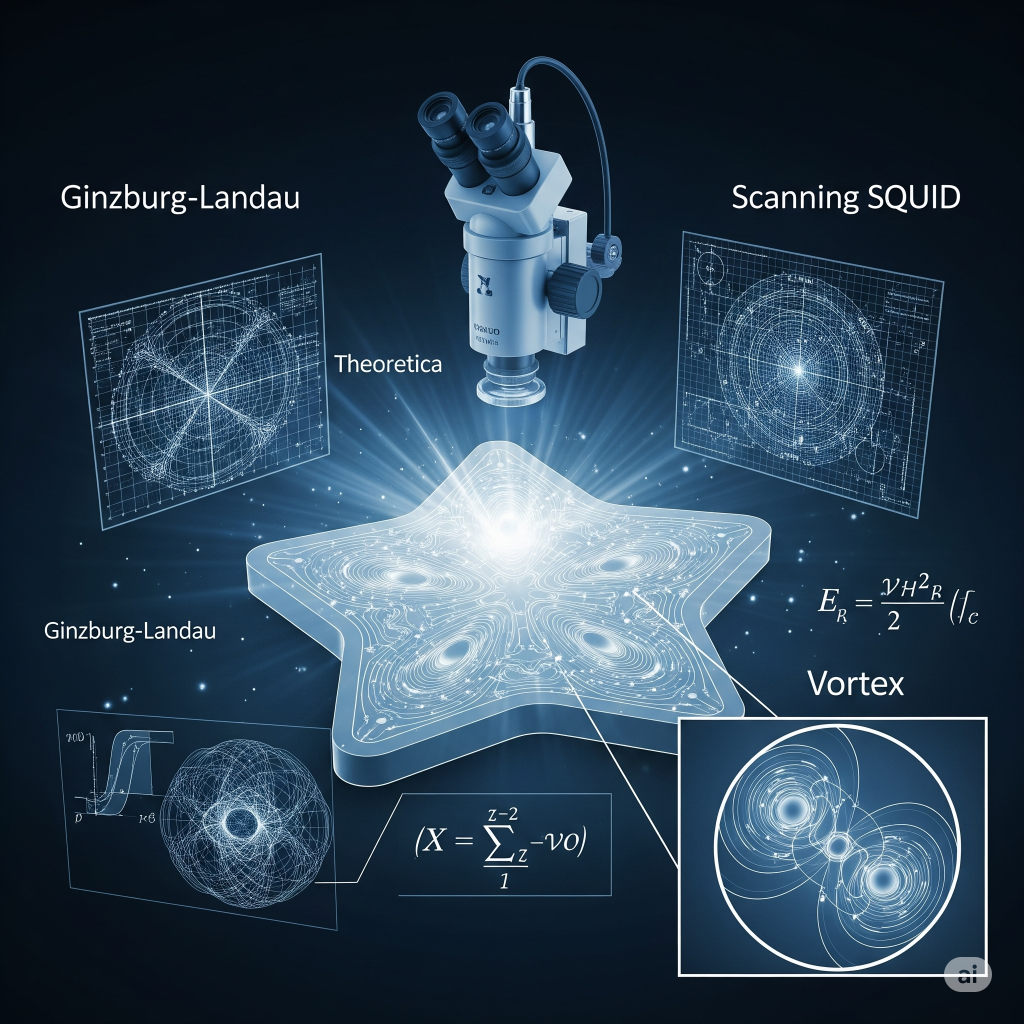
Summary of the paper
The study investigates the behavior of vortices in specially designed superconducting films. The research combines both theoretical calculations, using the Ginzburg-Landau equation and finite element method, with experimental observations performed via a scanning SQUID microscope. The primary goal was to understand how vortices arrange themselves into symmetric configurations as the applied magnetic field increases, particularly influenced by the unique star-shape of the Mo80Ge20 plate.
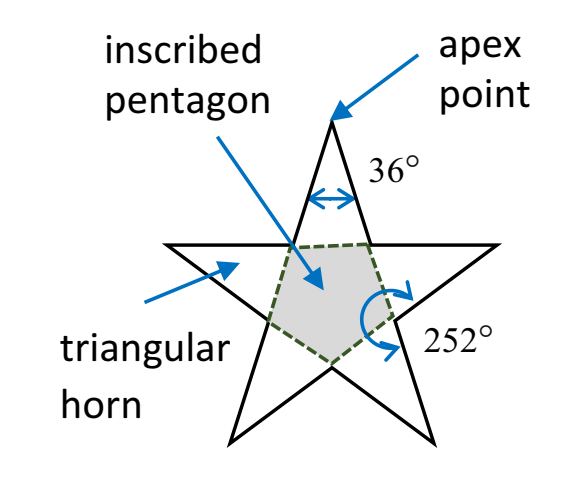
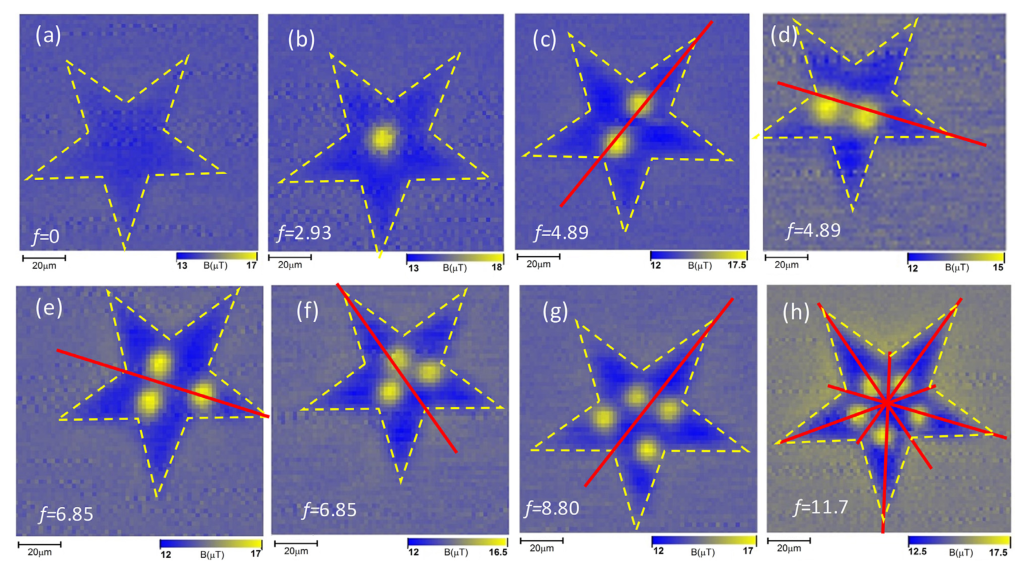
The experiments revealed a systematic evolution of vortex patterns with increasing magnetic field. For example, a single vortex appears at the center at low fields, while at higher fields, paired vortices align along the plate’s five-fold mirror symmetry axes. A significant finding was the emergence of a two-shell vortex structure for larger vorticities (L>5), where the outer shell consistently contained five vortices. This “magic number” of five in the outer shell is attributed to the geometrical matching effect provided by the triangular horns of the star-shaped plate. The study also noted that vortices tend to penetrate through vertices with wider inner angles due to reduced energy barriers.
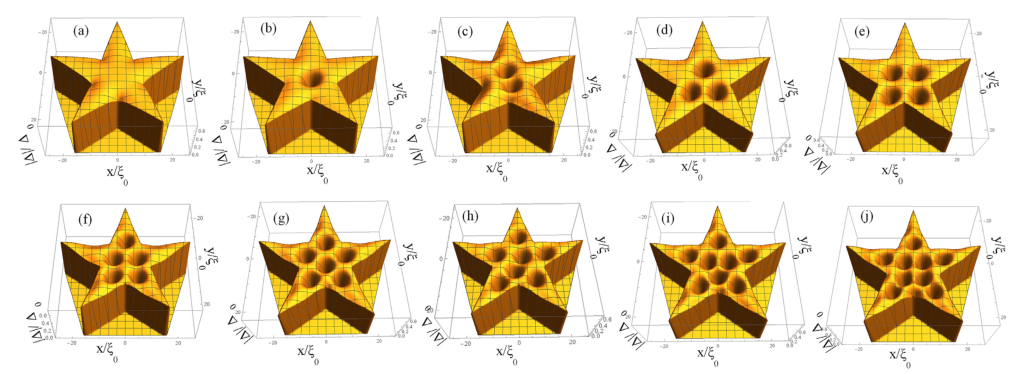
The theoretical predictions from the Ginzburg-Landau calculations largely showed good agreement with the experimental findings, confirming the observed vortex configurations, symmetry lines, and filling rules within the shells. Although a symmetric L=5 state was difficult to reproduce theoretically, the overall consistency highlights the strong influence of geometric confinement on vortex distribution in superconducting materials with intricate shapes. This research provides valuable insights into the fundamental physics of superconductivity and vortex manipulation in mesoscopic systems.
References
[1] A.A. Abrikosov, Sov. Phys. JEPT 5 (1957) 1174.
[2] N. Kokubo, S. Okayasu, A. Kanda, B. Shinozaki, Phys. Rev. B 82 (2010) 014501.
[3] L.R.E. Cabral, J. Albino Aguiar, Phys. Rev. B 80 (2009) 214533.
[4] L.R.E. Cabral, J. Barba-Ortega, C.C. de Souza Silva, J. Albino Aguiar, Physica C 470 (2011) 786.
[5] L.F. Chibotaru, A. Ceulemans, V. Bruyndoncx, V.V. Moshchalkov, Nature 408 (2000) 14.
[6] P.J. Pereira, L.F. Chibotaru, V.V. Moshchalkov, Phys. Rev. B 84 (2011) 144504.
[7] B.J. Baelus, F.M. Peeters, Phys. Rev. B 65 (2002) 104515.
[8] J. Pearl, Appl. Phys. Lett. 5 (1964) 65.
[9] T. Morooka, K. Tanaka, A. Odawara, S. Nakayama, A. Nagata, M. Ikeda, K. Chinone, Physica C 335 (2000) 157.
[10] N. Kokubo, S. Okayasu, A. Kanda, B. Shinozaki, Phys. Rev. B 82 (2010) 014501.
[11] B.L.T. Plourde, D.J. Van Harlingen, N. Saha, R. Besseling, M.B.S. Hesselberth, P.H. Kes, Phys. Rev. B 66 (2002) 054529.
[12] HoThanh Huy, M. Kato, O. Sato, M. Hayashi, T. Yotsuya, T. Ishida, Physica C 494 (2013) 99.
[13] N. Kokubo, S. Okayasu, T. Nojima, H. Tamochi, B. Shinozaki, J. Phys. Soc. Japan 83 (2014) 083704.
[14] HoT. Huy, M. Kato, T. Ishida, Supercond. Sci. Technol 26 (2013) 065001.
[15] N. Kokubo, S. Okayasu, B. Shinozaki, Physica C 468 (2008) 1316.
[16] HoT. Huy, H. Shishido, M. Hayashi, T. Yotsuya, M. Kato, T. Ishida, Physica C 484 (2013) 86.
[17] H.J. Zhao, V.R. Misko, F.M. Peeters, S. Dubonos, V. Oboznov, I.V. Grigorieva, Europhys. Lett. 83 (2008) 17008.
[18] L.R.E. Cabral, J. Albino Aguiar, Physica C 468 (2008) 722.
[19] H.J. Zhao, V.R. Misko, F.M. Peeters, V. Oboznov, S.V. Dubonos, I.V. Grigorieva, Phys. Rev. B 78 (2008) 104517.
[20] M. Kato, O. Sato, HoT. Huy, T. Ishida, Physica C 494 (2013) 124.
[21] M. Timmermans, L. Serrier-Garcia, M. Perini, J. Van de Vondel, V.V. Moshchalkov, Phys. Rev. B 93 (2016) 054514.
[22] B.J. Baelus, K. Kadowaki, F.M. Peeters, Phys. Rev. B 71 (2005) 024514.
[23] T.S. Alstrøm, M.P. Sørensen, N.F. Pedersen, S. Madsen, Acta Appl. Math 115 (2011) 63.