Superconducting neutron detectors CB-KID
1. Scientific background for the proposed research
Neutron beams are sensitive not only to certain light elements, such as hydrogen, lithium, boron, carbon and oxygen, but also to exceptionally heavy elements with high neutron absorption cross-sections, such as gadolinium, samarium, europium and cadmium. The characteristics of experiments conducted using neutron beams are thus remarkably different from those using X-ray, electron or proton beams. Neutron imaging has been used as a non-destructive technique for investigating materials via transmission spectra, pore structures, and neutron tomography. High-ended neutron detectors are indispensable in enhancing system performances of the instrumental system.
The CB-KID system was proposed as a superconducting neutron detector. Its operating principle is somewhat similar to a superconducting single photon detector (SSPD), but in contrast to SSPD, CB-KID works even under a small bias current. A transient change in the density of electrons in the superconducting wire ns occurs at a hot spot created by a passing charged particle (see next). The CB-KID was proposed for neutron imaging. When used for neutron imaging, a 10B conversion layer is needed to convert neutrons to charged particles, which in turn create hot spots in the meanderlines. London-Maxwell superconducting theory of CB-KID predicts that a negative pulse propagates in the downstream direction from the hot spot, while a positive pulse propagates upstream. A superconductor-insulator-superconductor planar structure in CB-KID provides an efficient waveguide to transmit electromagnetic pulse signals. This allows us a larger sensitive area of CB-KID as a neutron detector.
A spatial resolution for neutron imaging of 20 μm was reported using a scintillator camera detector using a CMOS sensor (D. S. Hussey et al., Nucl. Instruments Methods Phys. Res. A, 866, 9 (2017)). A 10B-doped multichannel plate was used for imaging with pulsed neutron sources with a resolution of 55 μm (A. S. Tremsin et al., Nucl. Instrum. Meth. Phys. Res. A 787, 20 (2015)). Our group developed the current-biased kinetic inductance detector (CB-KID) and demonstrated resolution of 22 μm (H. Shishido et al. Phys. Rev. Appl. 10, 044044 (2018)).
2. The purpose
This project aims at understanding the operating principle of a 4-CH delay-line current-biased kinetic inductance detector (CB-KID) system. It is undoubtedly important to improve the detection efficiency of the CB-KID. I revealed that the number of neutron-detecting events remarkably increased when the operating temperature of the CB-KID detector increased toward the superconducting critical temperature. However, the detailed mechanism and underlining physics have not been elucidated yet. I plan to investigate systematic behavior of the CB-KID as a function of operating temperature by building a precise temperature-control system. I believe that my findings from this research will contribute to understand the operating principle of CB-KID for pioneering the way of ripple effect of CB-KID to various applications.
3. Scientific significance
The operating principle of CB-KID with current-biased superconducting nanowires is fundamentally different from that of other neutron detectors. A phenomenological explanation is as follows: The kinetic inductance Lk of a superconducting nanowire is expressed as L_k=m_s l/n_s q_s2S , where Lk is the kinetic inductance, l is the total wire length, S is the cross-sectional area of the wire, ms is the effective mass, qs is the electric charge of the Cooper pair and ns is the Cooper pair density. A transient change in ns on the superconducting wire occurs when a local hot spot is created by the partial dissipation of kinetic energy by a charged particle originating from a 10B-neutron nuclear reaction in a 10B conversion layer. When a DC bias current Ib is fed into the superconducting nanowire, a pair of voltage pulses are generated at a hot spot within a tiny portion of the superconducting wire over length Δl (≪l) and the pulses propagate towards each end of the wire as electromagnetic wave packets with opposite polarities. A transient voltage V(t)across the hot spot is expressed asV(t)=I_b 〖dL〗_k/dt=I_b 〖dΔL〗_k/dt with a constant DC bias current in the superconducting zero-resistance state and a tiny fractional kinetic inductance ΔL_k=ms Δl/ns qs2 S . The bias current can be used to tune the signal amplitude so that it fits the sensitivity range of the signal capture instrumentation. A microscopic explanation of the CB-KID operating principle was given in an earlier work [T. Koyama and T. Ishida J. Phys. Conf. Ser. 1054 01205514 (2018)]. The spatiotemporal variation of the superconducting order parameter ψ(x,z,t) in the hot spot of the S-I-S waveguide and excites the phase oscillation modes that propagate as Swihart waves along the stripline.
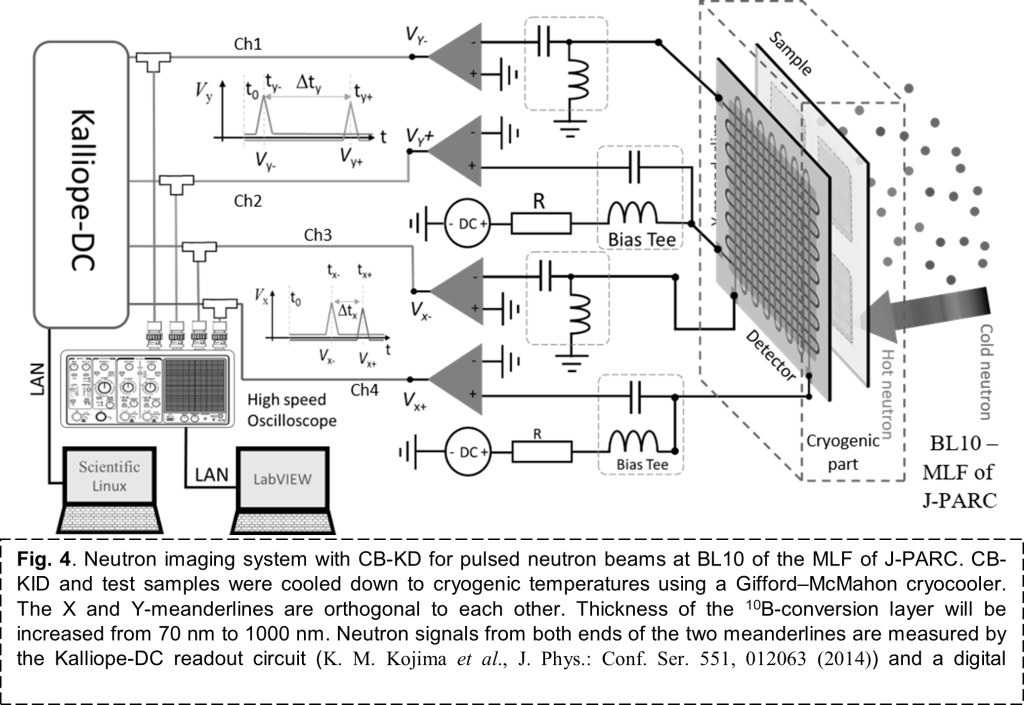
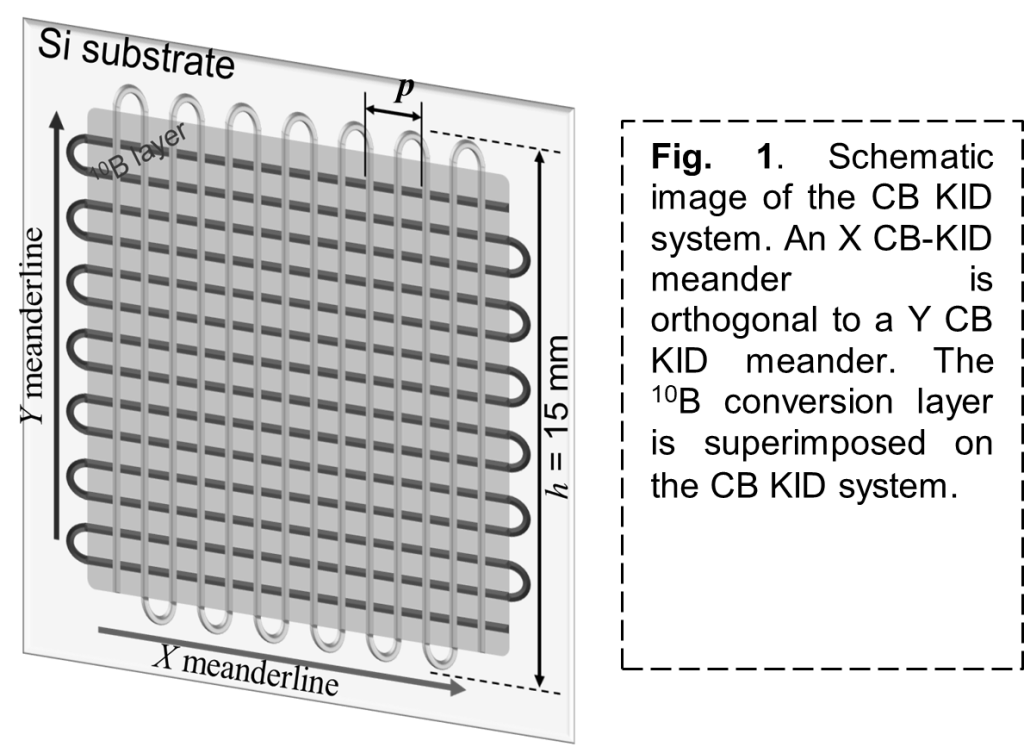
The delay-line CB-KID system must detect synchronized four outputs to identify the positions of hot spots created by passing charged particles. Two voltage pulses with opposite polarities originate at a hot spot on a meanderline and propagate as electromagnetic waves towards the output channels at each end of the meanderline. Using the propagation velocities along the X and Y meanderlines (vx and vy), and the arrival timestamps tCh1,tCh2,tCh3 , and tCh4 of the signals for each channel, the coordinate (X,Y) of the hot spot can be calculated as X=(tCh4-tCh3 ) vx p/2h and Y=(tCh2-tCh1 ) vy p/2h. Here, h is the length of each segment and p is the repetition period of the meanderline. The hotspot positions are used to render a neutron transmission image.
4. Originality of the research
It is quite original that I proposed a superconducting neutron detector because this detector is remarkably different from any other exiting (well-known) neutron detectors. This device is very compact than others because all the physical processes in the detector are confined to occur within a thin layer less than 1 mm in thickness. Operating principle has somewhat been understood so far. For example, we already understood how the neutron signal is created in the detector with the aid of the superconducting theory. However, the operating principle needs further understanding of underlining physics because the history of the superconducting neutron detector has been very limited compared to other neutron detectors.
5. what will be elucidated, and to what extent and how will it be pursued during the research period.
I explain how to proceed the agenda to obtain the fruitful results in this WAKATE project. My goal target for the detection efficiency is 10% by completing the present research.
- Detector fabrication: The superconducting detector is schematically shown in Fig. 1. I design a new detector using the computer aided design (CAD) and request the superconductive foundry CRAVITY of the AIST to fabricate it.
- 10B conversion layer: To obtain the neutron detection efficiency of 10%, I will prepare a thicker 10B neutron absorption layer of 1 µm on the top of CB-KID sensor using a molecular beam epitaxy (MBE) in ultra-high vacuum at Osaka Pref Univ.
- Measurement instrument: The instrumental system has constructed as explained (see below, Fig. 4). To investigate temperature-dependent properties of the CB-KID carefully, I upgrade a temperature controller with an AC bridge controller to achieve a precise temperature control. It is important to improve the stability of temperature (ΔT) is lower than ±0.005 K to suppress the variation of the signal propagation velocity less than 0.3%. I tune the detection counting of the CB-KID when a temperature is scanned from 4K to 9K under the precise control to find an optimum operating temperature of CB-KID. I also optimize the bias current Ib to improve the signal-to-noise ratio to enhance the efficiency.