Author: Vu The Dang
Japan’s journey in integrated circuit (IC) development is a fascinating blend of innovation, government strategy, and global competition. The key milestones can be listed:
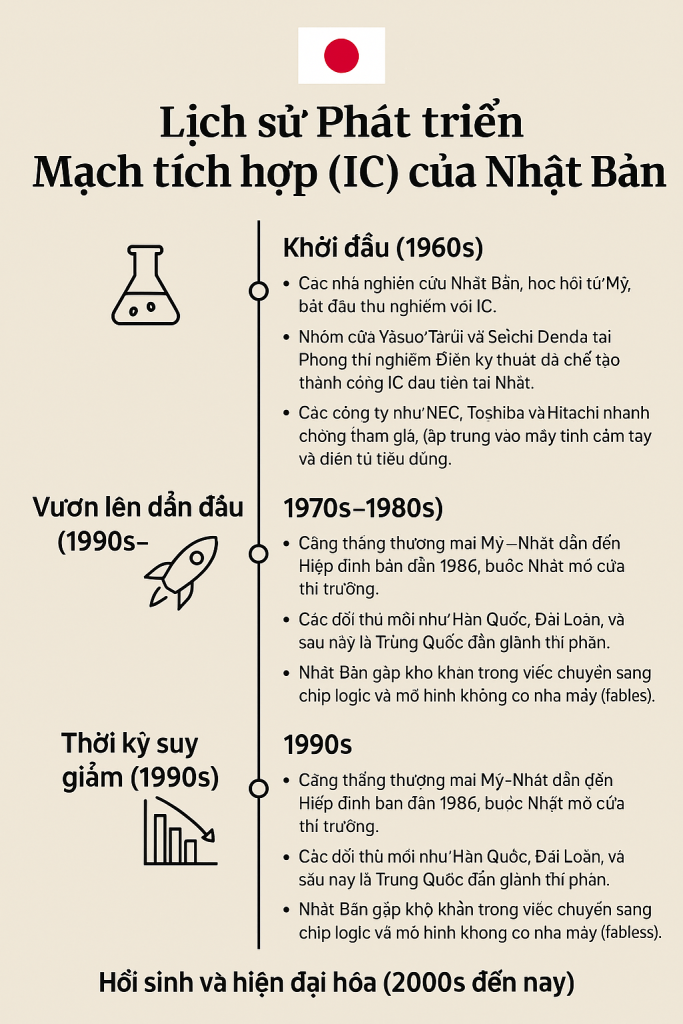
🧪 Early Beginnings (1960s)
- Japanese researchers, inspired by U.S. advancements, began experimenting with ICs through trial and error.
- A pioneering team led by Yasuo Tarui and Seiichi Denda at the Electrotechnical Laboratory successfully produced Japan’s first ICs [1].
- Domestic companies like NEC, Toshiba, and Hitachi quickly joined the race, focusing on calculators and consumer electronics.
🚀 Rise to Global Leadership (1970s–1980s)
- The Ministry of International Trade and Industry (MITI) designated semiconductors as a strategic industry, launching public-private R&D initiatives [1].
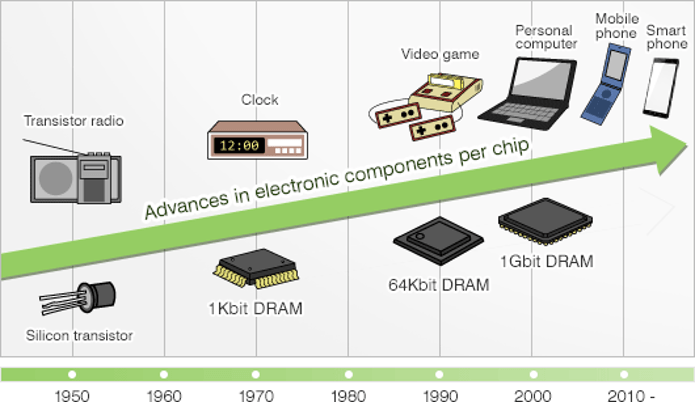
- Japan’s firms mastered DRAM and memory chip production, achieving high yields and reliability.
- By the mid-1980s, Japan controlled over 50% of the global semiconductor market, becoming a dominant force [1].
📉 Decline and Challenges (1990s)
- U.S.–Japan trade tensions led to the 1986 Semiconductor Agreement, which pressured Japan to open its market.
- Rising competition from South Korea, Taiwan, and later China eroded Japan’s market share [2].
- Japanese firms struggled to adapt to the shift toward logic chips and fabless models.
🔄 Resurgence and Modern Era (2000s–Present)
- Japan pivoted to specialty areas like semiconductor materials, equipment, and advanced packaging.
- Companies like Tokyo Electron and Shin-Etsu became global leaders in semiconductor tools and silicon wafers.
- Recent government efforts aim to revitalize domestic chip production, including partnerships with global firms and investment in cutting-edge fabs [1].