
1D SQUIDs sensors
Designed and Fabricated an single pickup coil SQUIDs sensors
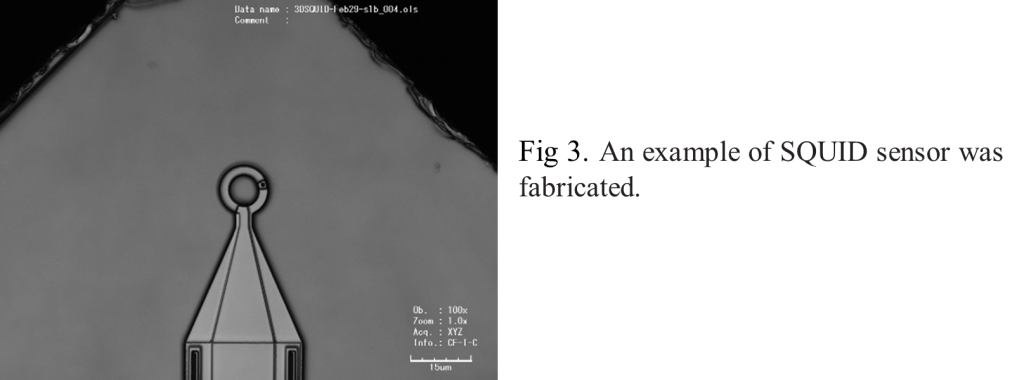
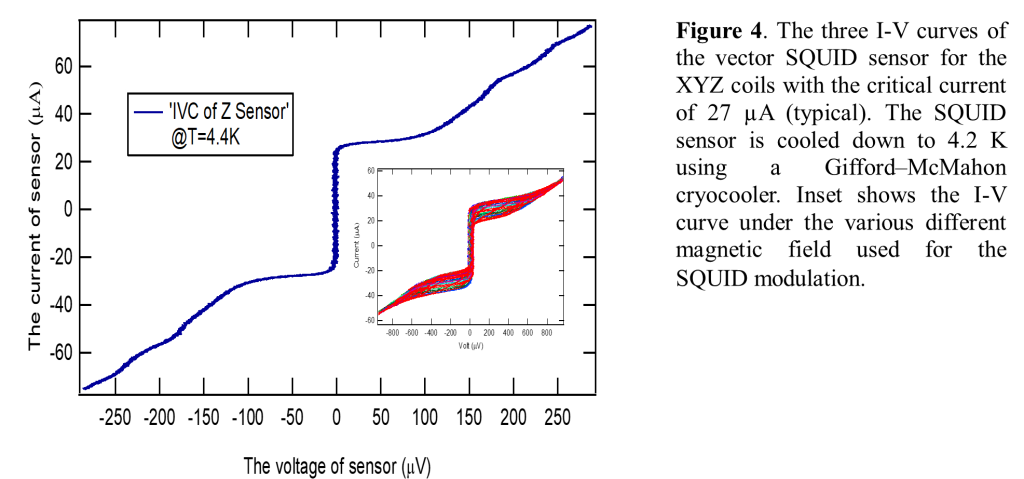
A scanning SQUID system is an important system to study about vortex state. Therefore, I constructed a concept model which was included 4 main parts: (1) low temperature system which the temperature can be cooled to 3k by using a 1 W Gifford–McMahon cryocooler; (2) The scanning system which consist of three piezo states with XYZ direction; (3) Electronics system is connected with computer to control scanning system, temperature, SQUID controller and data processing; (4) a vector SQUID sensor was connected with a commercial FLL electronics with 3 channel to readout the image of distributing magnetic field which was caught by vector pick up coil system. Beside, designs of scanning SQUID system, I also succeed in fabricating a vector SQUID sensor base on NEC Nb standard layout (AIST-STP2) in Cadence Layout software. The parameters of our sensor was fabricated consist of critical current density (Jc) of a JJ is 320 kA/cm2. The number of Nb layers remain to be four was employed a fabrication process provided by CRAVITY. Each JJ has the critical currents (Ic) of 12.5 µA with an area of 2 µm x 2 µm. The typical variation in JJ critical currents is better than 2% as revealed in the related publication. In order to measure the characteristics of a vector SQUID sensor, I constructed a measurement system of the I-V curve. It’s consist of a Gifford–McMahon cryocooler to reduce the temperature of a SQUID sensor down to 4 K; a current source to supply external magnetic field by driving the current thought external coil and a national instrument with ADC and DAC module to generate a signal to apply current into sensor and measure the voltage of sensor. They were connected with a LabVIEW program in computer to control, monitor and take data. Figure 4 shows the typical I-V curves of the SQUID sensor. The critical current Ic of sensor is 27 µA, which is in good agreement with our design value of 25 µA (= 2 x 12.5 µA). We installed an additional coil of 20 turns in our system to produce an external magnetic field at the position of the sensor, where the pick-up coils were placed at the center of the 20 turns coil. We applied an external magnetic field so as to adjust a current fed into the 20-turn coil. The inset of Figure 4 shows that there is an oscillation in the I-V curves when the external magnetic field is changed systematically. All of measurement results confirm that we fabricated the SQUID sensors successfully as designed by us [4]. A concept measurement system which were combined SQUID sensor and scanning SQUID system presented at ISEC2015 conference and extended abstract was published at IEEE ISEC 2015 proceedings [3].
Achievements
- The systematic measurement made on specific geometrical superconductor and an artificial element such as star-shaped pattern without pinning and pinning and a circular with sector defect, allows me to trace out not only how the vortex pattern evolves with magnetic field under influence by sample geometry but also how to control the distribution of vortex by introducing an artificial element.
- By applying the numerical image processing technique, the spatial resolution of SSM can be significantly improved beyond the physical limitation of pickup coil on the basis of my measurements.
- A concept of scanning SQUID system and SQUID sensor was fabricated. The parameters of my study showed promising characteristics, they will be helpful to optimize size, shapes and position of pick up coils to improve sensitive of sensor in next designs.
Reference
[1]. Vu The Dang, Hitoshi Matsumoto, Hiroki Miyoshi, Ho Thanh Huy, Hiroaki Shishido, Masaru Kato and Takekazu Ishida, “Vortex Distribution in Small Star-Shaped Mo80Ge20 Plate”, Physica C, Vol. 533(2017), Pages 44–48.
[2] Vu The Dang, Ho Thanh Huy, Hitoshi Matsumoto, Hiroki Miyoshi , Shigeyuki Miyajima, Hiroaki Shishido, Masaru Kato and Takekazu Ishida, “Ginzburg-Landau calculations of circular Mo80Ge20 plates with sector defect”, Physics Procedia Vol. 81, pp. 93-96. DOI:10.1016/j.phpro.2016.04.036.
[3]. Vu The Dang, Ho Thanh Huy, Shigeyuki Miyajima, Hitoshi Matsumoto, Hiroki Miyoshi, Takuto Okamoto, Masaaki Maezawa, Mutsuo Hidaka and Takekazu Ishida, “Scanning SQUID Microscope for Sensing Vector Magnetic Field”, Journal of IEEE, ISEC2015 (2015), 15721011. DOI:10.1109/ISEC.2015.7383478.
[4] Vu The Dang, Masaki Toji, Ho Thanh Huy, Shigeyuki Miyajima, Hiroaki Shishido, Mutsuo Hidaka, Masahiko Hayashi and Takekazu Ishida,”Vector sensor for scanning SQUID microscopy” Journal of Physics: Conference Series (JPCS). (Accepted for publication).